
Conference icebreaker questions: the printable PDF list
The best icebreaker questions give attendees a problem to share or a decision to compare, not a social performance like 'tell us something surprising'.
Co-founder and Product Lead, All Along

The best conference icebreaker questions hand people a live problem to compare, not a social performance. The strongest single prompt is a version of 'what are you trying to figure out this year' - it works across sectors and seniority. Time-box every answer - 30 seconds a person in a triad, 60 in a matched pair. Here is what makes a prompt work, and the printable list itself.
I keep a short list of icebreaker questions on my phone and hand a printed copy to every facilitator I work with. Most organisers I know have some version of this - a document that moves between events, gets added to, gets pruned, and quietly keeps the networking layer from falling over.
This post is that list. Thirty questions, grouped by the moment they belong to, with notes on how long each one takes and what it actually produces in the room. The one-page PDF above is the printable version - grab it, customise it, hand it to your team the morning of the event. That is the whole system. Icebreaker questions slot into whichever conference session formats you are running - the right question depends on the format and the moment.
Before the questions, a short note on which ones work and which ones don't - because the format matters more than the specific wording. Feel free to skip to the question bank if you just need the list.
What makes a good conference icebreaker question
The failure mode of a bad icebreaker question is predictable. It optimises for ease - anyone can answer it, nobody feels put on the spot - and in doing so strips out anything professional. 'Tell us a fun fact about yourself' meets that bar. So does 'share your superpower'. Both produce activity. Neither produces anything the two people involved can return to an hour later at the coffee break.
The research on professional networking points in the same direction. A 2016 Harvard Business Review study by Casciaro, Gino and Kouchaki found that people network more effectively when they approach the interaction in an information-seeking mindset rather than a performance mindset. (HBR, 2016) Performative prompts push people into performance mode at exactly the wrong moment. Information-seeking prompts - a specific problem, a live decision, a shared constraint - do the opposite.
My take: the single best litmus test for any icebreaker question is this - could the two people involved reference this answer again later in the day? If the answer is no, the question is probably wrong.
The five features the questions below share:
- Professional content at the core - a problem, a goal, a decision, a change, a constraint.
- Time-boxed answers - 30, 60 or 90 seconds. Never open-ended.
- A specific frame - 'this year', 'this quarter', 'in your role right now'. Never abstract.
- Callback potential - produces something referenceable later.
- Works across sectors - no industry jargon, no presumed context.
For the full thinking on icebreaker formats - as opposed to the questions that power them - see event networking icebreakers that work.
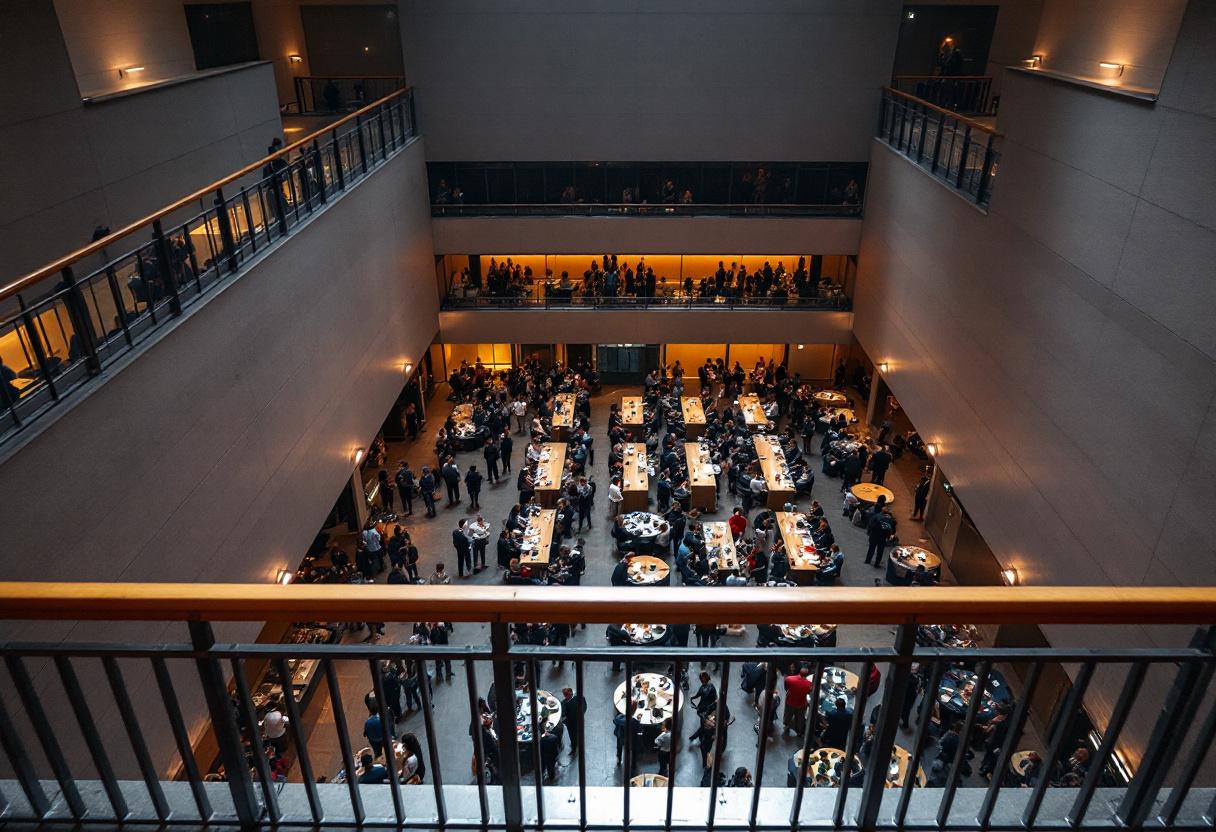
The question bank, by moment
Thirty questions, grouped by when they belong in the programme. Pick one or two per category and rotate across the days. Don't use the same prompt at every interaction format - that's the single most common operational mistake.
Arrival and the first hour (60-90 seconds per answer)
Use these at registration, in the opening plenary, or as a whole-room 'turn to the person next to you' prompt in the first thirty minutes of the event.
- What's the one thing you're hoping to figure out by the end of this conference?
- What made you pick this conference this year over the others on your list?
- What's the most useful thing you've read this month about your work?
- Who are you hoping to meet at this event - by role or type, not name?
- What's one thing you want to stop doing at work in the next six months?
- What's a problem you've made zero progress on so far this year?
Freeman's 2025 Networking Trends Report found that 58% of attendees now say networking is their primary reason for attending in-person events. (Freeman, 2025) The first hour is when that intent is highest. Waste it with a fun-fact icebreaker and you've burned the moment you can't recreate later.
Matched pair introductions (60 seconds per answer)
When you've pre-matched two attendees and put them in a room together, these are the prompts that stop the conversation defaulting to corporate bios. Works best with a structured intro programme - see pre-event networking for the registration data that makes matching scalable.
- Tell me about something you worked on last month that didn't go the way you planned.
- What are you measured on this year, and where is it going well?
- If you could only solve one thing for your team in the next quarter, what would it be?
- What's one decision on your plate right now that you'd like a second opinion on?
- What's the most useful conversation you've had at a conference in the last five years?
- What's changed most about your work in the last twelve months?
Triads and small groups (30 seconds per answer, 4-6 minutes total)
Groups of three, one question, 30 seconds each, one follow-up question from the listener. The triad is the most reliable unit of interaction at a conference - small enough that everyone talks, large enough that it doesn't feel like an interrogation.
- What's changed most in your role in the last year?
- What's a tool or habit you've adopted this year that you'd recommend?
- What are you saying no to more often now than you did a year ago?
- What's a view you've changed your mind about recently at work?
- What's a counter-example to today's conference theme you've actually seen work?
- What's the one question you wish someone would ask you about your role right now?
Session openings and roundtables (90 seconds per answer)
For the five or ten minutes at the start of a session or a roundtable where you want to pull the room into the discussion before the speaker takes the floor. Also works as the opening frame for a roundtable format where you want structured peer discussion.
- In one sentence, what's the question you hope this session answers?
- What's the single biggest constraint on doing your role well right now?
- If we walked out of this session with one action, what should it be?
- What's a false consensus in our industry that we should be pushing back on?
- What's a number your team is watching closely this year, and why that one?
- What's one thing about this topic that you think most people get wrong?
MPI's Meetings Outlook research has consistently found that session design - the format of connection, not just the content - is where organisers get the most leverage. (MPI, 2024) The opening prompt is the first piece of that design.
Closing and post-event follow-up (60 seconds per answer)
For the last session, the closing reception, or the follow-up message a day or two after the event. These convert the connections you made in the room into something that actually travels.
- Who did you meet today who surprised you, and what did they say?
- What's the one thing you're taking back to your team tomorrow?
- If you were running this conference next year, what's the first thing you'd change?
- What do you now know that you didn't at nine o'clock this morning?
- Which conversation today would you most like to continue in the next month?
- What's a specific thing I said that you'd like to follow up on? Who else at this conference should we both be in touch with?
How to run these at a conference
Five short rules on the operational side - the stuff that determines whether the list works or just sits in the organiser's notebook.
Pick one per moment, not one for the whole day. Using the same prompt at arrival, in the session opener, at the roundtable and at the closing reception is the fastest way to watch energy drain out of the room. Rotate across the bank.
Time-box every answer. Tell facilitators exactly how long each answer should be. 30 seconds in a triad, 60 in a matched pair, 90 for a goal-share. Open-ended produces anxiety, especially at scale.
Put the prompt where it's being used. On the session slide, on the table card, on the speed-networking rotation sheet. Attendees should not have to remember the question mid-exercise. The more visible the prompt, the cleaner the interaction.
Hand facilitators a printed reference sheet. Print the whole list as a one-pager and give it to session chairs, volunteer hosts, MCs and anyone running a breakout the morning of the event. Nobody pulls out a phone mid-introduction.
Rotate across days. On a multi-day conference, don't reuse the opening prompt from day one on day two. The bank exists so facilitators have options when a session needs a different kind of opener.
If you want to see how these prompts sit inside a broader attendee journey, the conference attendee engagement strategy post walks through the full first-hour-to-follow-up arc.
Making it a printable reference
The one-page PDF linked at the top of this post is the version we hand to facilitators at All Along events. A4, grouped by moment, time-boxes next to each heading, and three editable fields at the top for event name, session and facilitator. Download it, print it, hand it out at the morning briefing.
If you want to adapt it for your event, three steps:
- Open the PDF in Preview or Adobe and fill in the event, session and facilitator fields before printing - or rebuild it in a document of your choosing using the same five groupings.
- Prune ruthlessly. Keep six to ten questions per event, not thirty. Your facilitators need a usable reference, not a menu to hunt through. Pick the ones that match your programme, sector and audience seniority.
- Print one copy per session chair, volunteer host, MC and anyone running a breakout. The briefing conversation the morning of the event is where this document earns its keep - not a week later in someone's inbox.
A printed sheet in a facilitator's hand beats an app on their phone every time. The generic question lists that circulate online are fine as starting points - the real value is the version you've pruned, numbered and put into the hands of the people running the sessions.
If you want a quick diagnostic on where your event's networking design currently stands - the place where the question list is one lever among several - the networking gap calculator walks through the numbers in about two minutes.
Want the template I use when I plan networking into an event agenda?
I put a short operator's brief together - the three registration questions, the match format decision tree, the post-event follow-up template. Free, no email wall.
Frequently asked questions
What makes a good conference icebreaker question?
A good conference icebreaker question gives attendees something professional to work on together rather than a social performance to get through. It names a specific problem, goal or decision, keeps the answer short (under a minute), and produces content that can be referenced again later in the day. Questions like 'what are you trying to solve this year' or 'what's one decision you're weighing right now' work across sectors and seniority levels. Questions like 'tell us a fun fact about yourself' or 'share your superpower' produce activity without professional substance and rarely lead to a second conversation.
What are the best icebreaker questions for a large conference?
At a large conference (300+ attendees), the best icebreaker questions are ones that work at breakout or table level rather than across the full room. A triad prompt - groups of three, 30 seconds each, one follow-up question - scales cleanly because the unit stays small regardless of the room size. 'What are you here to figure out this week' and 'what's the single biggest constraint on doing your role well right now' are two that consistently work because they pull professional content forward without making anyone perform. Whole-room open instructions to 'find two new people' are the most common failure mode at scale - the resulting noise and anxiety serves nobody.
How many icebreaker questions should I prepare for a conference?
Eight to twelve is the right range for a multi-day conference. Any fewer and you run out of prompts by mid-afternoon on day one. Any more and facilitators start reaching for the wrong question for the moment. Group the list by moment - arrival and first hour, pre-matched pair introductions, triads and small groups, session openings and roundtables, closing and post-event. Pick two or three per category. The goal isn't variety for its own sake; it's having the right prompt ready for each distinct interaction format on the agenda.
Should conference icebreaker questions be printed or handed out digitally?
Both, for different audiences. Print the list as a one-page reference sheet and hand it to every facilitator, session chair, volunteer host and MC the morning of the event. Nobody pulls out a phone mid-introduction to look up a prompt. For attendees, the prompts should show up on session slides or handouts at the moment they're being used - not in an app that requires navigating to find them. A printed reference for the people running the sessions plus a visible prompt on-screen for attendees is the combination that consistently works.
How do you adapt icebreaker questions for virtual or hybrid conferences?
Shorten the questions, shorten the answers, and move more of the interaction into chat. In-person a triad can run for three minutes. In a video room it runs for 90 seconds before attention drops. Questions with shorter, more specific answers work better on video: 'What's one thing you've changed your mind about this quarter?' beats open-ended goal-sharing. In chat-based formats, prompts that invite a one-sentence answer from everyone simultaneously - rather than a round-robin - scale better and pull more voices in. For hybrid, run the question in both rooms but accept that the in-person and virtual answers will differ in depth, and design the prompt to surface useful content in both.
About the author
Cate Trotter
Co-founder and Product Lead, All Along
Cate is co-founder and product lead at All Along. She's spent 15+ years helping organisations turn emerging tech into commercial results, and founded and sold two retail-focused businesses before building All Along. She writes about how events can turn networking from a happy accident into a repeatable outcome.
Connect on LinkedInReady to make networking the reason people come back?
All Along gives every attendee three people they should actually meet, and gives you a complete picture of what your audience wants.
More from Field Notes
How to increase member engagement without adding more content
The five steps I'd take to increase member engagement, in order, with the metrics worth tracking and the ones worth dropping.
A community manager job description that hires connectors
Most community manager job descriptions hire a content producer and wonder why retention doesn't move. Here's the one I'd write for a connector instead.
How to build the business case for event networking
Networking gets cut first because organisers pitch it as a vibe, not a business. Here's the case I write when a CFO is sharpening the red pen.