
Why your big conference needs micro networking events
PCMA's Convene research finds attendees rate small, hosted formats as the highest-value moments at any large conference, above the keynote and the gala.
Co-founder and GTM Lead, All Along

Big conferences lose people in the crowd, and the fix is not a bigger room. Small hosted sessions - a dinner for ten, a breakfast with one question on the table, a walking tour - are what attendees rate highest at a large event, above keynotes and galas, according to PCMA's Convene research (2025). They cost time rather than budget. Here are five formats and how to staff them.
I have spent the last few months helping organisers think about what to do when their conference grows past five hundred people. The agenda gets longer, the venue gets bigger, the sponsor count goes up, and the room slowly becomes harder to be a person in.
The reflex is to add stage capacity, more tracks, more food stations, a second hall. The thing that actually moves the needle is the opposite. The bigger the conference, the smaller the formats inside it need to be. The reverse holds too: a small conference needs a different networking strategy from the start, because its edge is an intimacy you lose by copying big-event formats.
That is what micro networking events are. Hosted dinners, breakfasts, walking tours, interest huddles, named-pair coffees - eight to twenty attendees each, one host, one purpose. They are the conference within the conference, and most organisers under-use them by an order of magnitude. They slot in alongside the other conference session formats on the programme - they are not a replacement for panels or plenaries, but a complement.
The scale problem nobody designs around
Walk a 5,000-person summit at the welcome reception and count the people standing in tight clusters with people they already know. It will be most of the room. The rest are circling - reading the sponsor signage, checking their phones, working out whether they can leave at 7.30pm without it being weird.
That is not a personality problem. It is a format problem. Open mingling at scale is optimised for the loudest fifth of the audience. Everyone else is paying a tax to be there.
Freeman's 2025 Networking Trends Report makes the structural point cleanly: 58% of attendees now say networking is their primary reason for attending events, up from 39% in 2021, but 60% of event teams do not actively manage networking at all (Freeman, 2025). The bigger the venue, the bigger that gap gets. With 200 attendees you can sort of muddle through. With 2,000 attendees the muddle is the thing.
My take: organisers keep treating scale as a logistics problem - more food, more wifi, more loos. It is a design problem. The attendee tax of a 2,000-person open-bar reception is bigger than the tax of a 200-person one, not smaller, and the design needs to bend the other way.
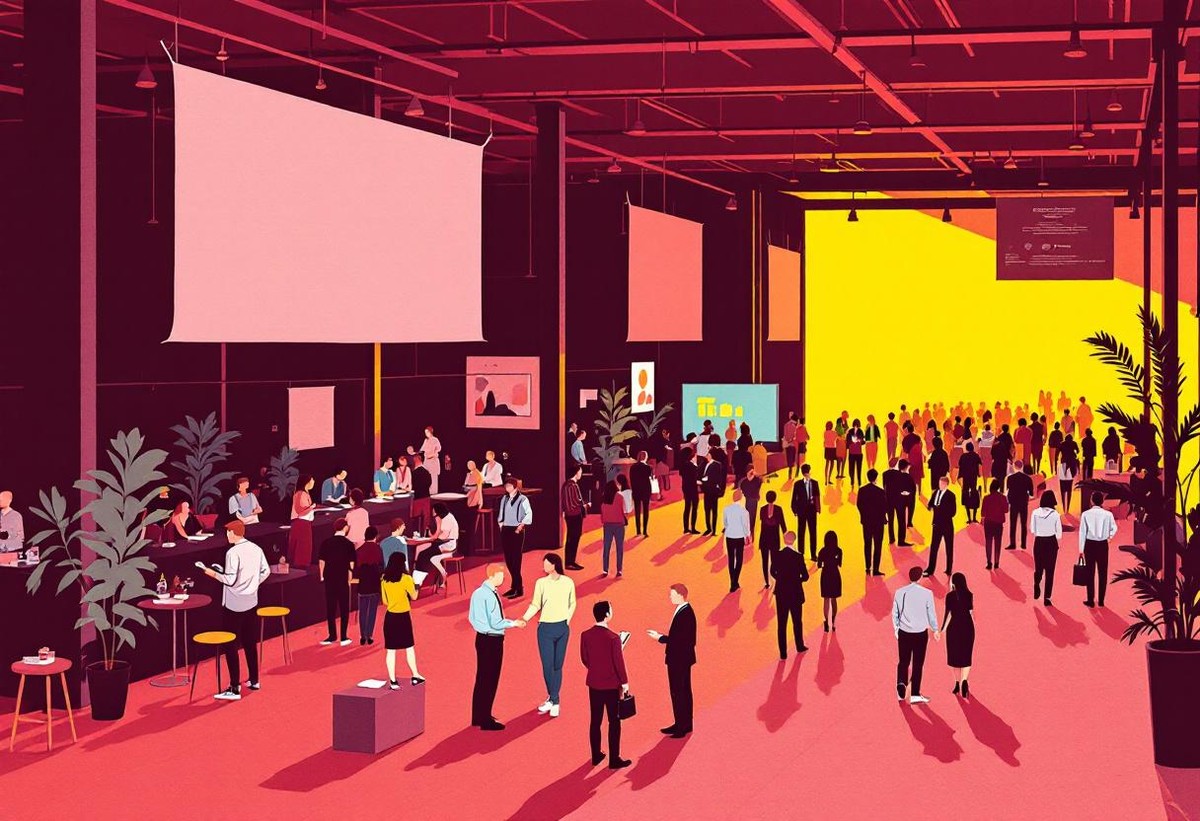
What 'micro networking events' actually means
A micro networking event is a small, hosted sub-event that sits inside a larger conference. Eight to twenty attendees. One host. One stated purpose. A fixed end time. Usually inside the existing venue or within walking distance, on furniture the venue already owns.
The shorthand I use with organisers: it is a moment with a guest list. The big event has a programme; the micro event has a guest list. That single shift - from 'whoever shows up' to 'these eight people, here, now, for this' - is what moves the format from a coffee break into a structured connection. The tool that makes that guest list work is a one-page match card for each person in the room.
It is not a track. Tracks are still 200-300 people listening to a stage. A micro event is the opposite. It is everyone around the table speaking at least once, including the introvert, the first-timer and the senior person who is tired.
It also is not an inclusive networking idea layered onto an existing room. It is a separate format with its own time, its own host, and its own attendee list - which is why it works for the people that the default room ignores.
Five formats that consistently work
These are the five I keep recommending to organisers. None of them are exotic. All of them have to be deliberately scheduled, named on the agenda, and given a host with a brief.
Hosted dinners (8-10 guests, one question on the table). Pick a venue inside walking distance. Brief the host on a single question - 'what would change if procurement teams could see sustainability data in real time?'. Eight people, two hours, printed name cards. The host opens with the question. By dessert every attendee has spoken three times. PCMA's Convene research consistently rates this format as the highest-value moment at any large event (PCMA Convene, 2025).
Industry breakfasts (60 minutes, name cards, one question). Same logic, lower stakes. Run before day-two sessions. People eat slower than they drink, the room is not yet noisy, and there is no hangover-anxiety overhang from the night before. Best format for first-time attendees and senior leaders who do not want to do the bar.
Walking tours of the host city (12-20 attendees, a real route, a real guide). Pre-conference Sunday afternoon, or a 90-minute lunch break. Walking removes the need to perform. Conversations happen in pairs and threes that re-shuffle every ten minutes. Add a real guide - architecture, food, industrial heritage - and the attendees come back into the venue with a shared frame of reference.
Interest huddles (6-8 people around a real problem). A roundtable, but the host is an attendee solving the problem live - 'I am rebuilding our member onboarding flow next quarter, here is the draft, what would you change?'. Different from a conference roundtable format in that the host has a real artefact in the room and the goal is to leave with a better version of it.
Named-pair coffees (the organiser tells two attendees they should meet). The lowest-cost format on the list. Twenty minutes, two named people, one explicit reason - 'Sarah is rebuilding what you rebuilt last year, you should meet'. Seventy named pairs at a 500-person conference is two days of organiser time and the single highest-rated thing in most post-event surveys I have read.
How to design your first one
You do not need a programme overhaul. Pick one block of an existing event and run this sequence.
Start with the agenda. Find the moment where the default is open mingling - welcome reception, night-one dinner, second-day breakfast. That is the block to replace. Pick three to five hosted formats and let attendees choose their preferred one in advance, the same way they would pick a session track.
Then pick the formats and the hosts. Match each micro event to someone who can hold a table and ask a real question. Speakers will host a dinner the night they present surprisingly often, especially if it widens the audience for their talk. Sponsors are the other obvious source - clearly labelled, so attendees can opt in or out. The third pool is attendees themselves; a senior practitioner offered the chance to host eight peers around their actual problem will rarely say no.
Brief the host in sixty seconds. Send a short note: who is at the table, what the one question on the table is, what time you need them to wrap. Most hosts over-prepare. The brief exists to stop them turning a dinner into a panel.
Add a single routing question to registration. 'How do you do your best networking - small group, written intro, scheduled meeting, or in the corridor?'. Use the answers to suggest the right micro event to each attendee, and to size the formats by demand. The question pairs naturally with the broader pre-event networking you are probably already running.
Then measure the right thing. Forget event satisfaction score. Ask: 'did you have at least one conversation that was worth your time?'. Cross-tab the answers by who attended which micro event. The pattern that comes back is your briefing for next year.

The commercial case for the format
Most renewal data I have seen shows the same thing. Attendees come back to events where they had at least one conversation worth having. They do not come back because the keynote was good. The keynote is forgettable; the dinner is not.
The HBR research on networking by Casciaro, Gino and Kouchaki makes the underlying point well: people experience networking as more authentic, and less uncomfortable, when they approach it as a shared task rather than a self-promotional exercise (Harvard Business Review, 2016). Hosted formats with a stated question are exactly that. The shared task is in the room.
The Skift Meetings 2025 megatrend write-up describes the same shift on the demand side - attendees increasingly judge events by 'time to first useful conversation', and the events that win on that metric are the ones with structured small-group moments baked into the agenda (Skift Meetings, 2025). The big stage is no longer the differentiator. The small table is.
A conference of 5,000 attendees that runs ten micro events of ten people each has 100 attendees who walk out with a real connection. Those 100 carry the renewal curve. They are also the ones who tell colleagues about the event when they get back to the office. That is where the commercial case lives - not in the feedback form, in the booking the year after.
If you would like to pressure-test where your existing event sits before you change anything, the free networking gap calculator scores six dimensions, including how much of your agenda is structured small-group time. It is a quick read, and it gives you the gap before you brief anyone on closing it.
Bigger events do not need to feel bigger to the people in them. With ten well-hosted micro events on the agenda, a 5,000-person summit can feel like ten parallel 200-person ones - which is the size every attendee remembers. That is the conference within the conference, and it is the cheapest upgrade most organisers are not running.
All Along exists partly to make the routing and measurement work above run on rails - which attendee should be in which micro event, who hosted what, what each pair produced. The disciplines themselves work on a clipboard.
Want the template I use when I plan micro networking events into a conference agenda?
I put a short operator's brief together - the registration routing question, the host briefing template, the format decision tree, the post-event measurement question. Free, no email wall.
Frequently asked questions
What are micro networking events within conferences?
Micro networking events are small, hosted sub-events that sit inside a larger conference - typically eight to twenty attendees, one host, one stated purpose, and a fixed end time. Common formats include hosted dinners, hosted breakfasts, walking tours, interest huddles around a stated problem, and named-pair coffees where the organiser introduces two specific people. The point of them is to give attendees who would otherwise drift in the crowd a structured moment of conversation that the rest of the conference does not have time for.
Why do micro networking events work better than the main conference reception?
The main reception is optimised for the people who already know how to work a room - confident, well-connected, comfortable interrupting strangers. That is roughly one fifth of any audience. Micro networking events redistribute attention. With eight people at a table and one stated purpose, every attendee speaks at least once, the host can name what is on offer, and the introvert in the corner is not left to compete for eye contact. PCMA's Convene research shows attendees consistently rate small, hosted formats above keynotes, galas and open-bar receptions for value per minute.
How many micro events should a conference run?
As a starting heuristic, run one micro event per fifty attendees per day. A 500-person conference can comfortably support ten micro events across a two-day programme without overloading the agenda or the team. Bigger events scale by topic, not by capacity - a 5,000-person summit might run twelve hosted dinners on different industry verticals on the same evening, each with its own host. The constraint is the number of credible hosts you can brief, not the venue or the attendee appetite.
Who hosts a micro networking event?
Anyone who can hold a table and ask a real question. Speakers are an obvious source - many will host a dinner the night they present, especially if it widens the audience for their talk. Sponsors are the other obvious source, though sponsor-hosted events should be clearly labelled so attendees can opt in or out with eyes open. The third pool is attendees themselves: a senior practitioner offered the chance to host eight peers around their actual problem will rarely say no, and the format scales much further than relying on speakers and sponsors alone.
How do I add micro networking events to a conference that is already planned?
Pick one moment in the agenda where the default is open mingling - the welcome reception, the night-one dinner, the second-day breakfast. Replace one block with three to five hosted formats and let attendees choose their preferred one in advance. Add a single registration question - 'how do you do your best networking - small group, written intro, scheduled meeting, or in the corridor?' - and use the answers to route people. None of this requires new software or a new budget line. It requires deciding that the default open-bar hour is not free, even when the venue throws it in.
About the author
Alex Shiell
Co-founder and GTM Lead, All Along
Alex is co-founder and GTM lead at All Along. She spends her days talking to event organisers, associations and sponsors about what they need from networking - and turning those conversations into product and commercial decisions. She writes about the operational side of events: registration data, sponsor ROI, adoption and the organiser craft.
Connect on LinkedInReady to make networking the reason people come back?
All Along gives every attendee three people they should actually meet, and gives you a complete picture of what your audience wants.
More from Field Notes
How to increase member engagement without adding more content
The five steps I'd take to increase member engagement, in order, with the metrics worth tracking and the ones worth dropping.
A community manager job description that hires connectors
Most community manager job descriptions hire a content producer and wonder why retention doesn't move. Here's the one I'd write for a connector instead.
How to build the business case for event networking
Networking gets cut first because organisers pitch it as a vibe, not a business. Here's the case I write when a CFO is sharpening the red pen.