
Speaker selection is a networking decision, not a marketing one
The speakers who sell the most tickets often produce the least networking. A point of view that divides the room beats a famous name for conversation.
Co-founder and Product Lead, All Along

Choose speakers for the conversations they leave behind, not the tickets they sell. The ones who produce the most networking are catalysts - a strong point of view, a question that divides the room, a willingness to name what is actually happening in their industry. A programme with four marquee names and no catalyst will look great and feel quiet. Here is how to spot them, and the mix I would aim for.
Most programme committees I have sat on treat speaker selection as a marketing decision. The question on the table is always 'who will sell tickets'. The question almost nobody asks is 'who will produce the most useful conversations in the room'.
Those are not the same question. And the speakers who score highest on the first one are very often the speakers who score lowest on the second.
I keep coming back to this because it is where the most expensive mistake in conference design is hiding. A famous keynote costs a lot of money. If they sell tickets but produce no conversation, the event is spending networking budget on marketing outcomes and calling it a success.
The framing problem
Speaker selection sits in an organisational no-man's-land. Marketing wants names that sell. The programme team wants voices that fit the theme. Sponsors want speakers who reflect well on their logo. Nobody explicitly owns the question of which speakers will make attendees turn to each other afterwards.
That is the networking job. And because nobody owns it, nobody scores for it or against it. Speakers get picked on applause lines and ticket sales, and the networking quality of the session is treated as a happy accident if it happens.
My take: this is one of the three or four decisions in conference design that has the biggest impact on whether networking actually works, and it is made almost entirely on non-networking criteria.
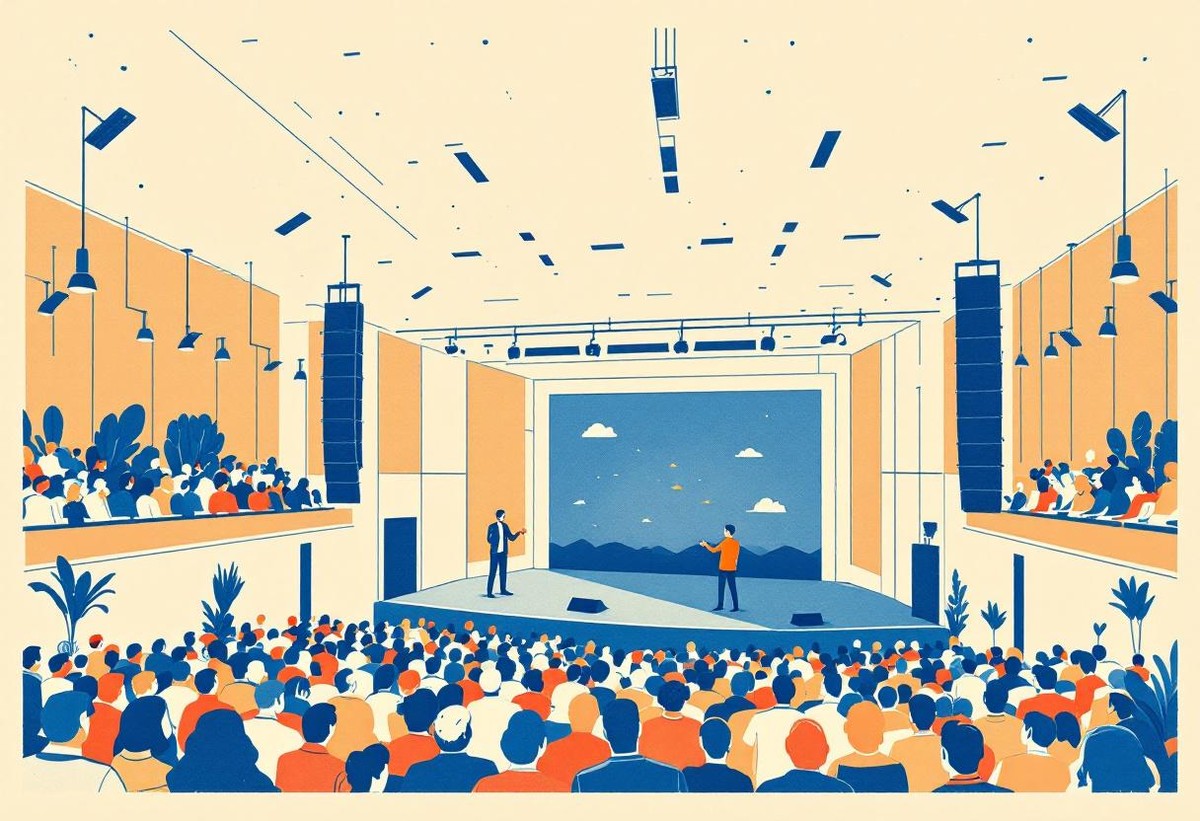
Marquee speakers vs catalyst speakers
I find it useful to separate speakers into two categories. Marquee and catalyst. Both can be great. They do different jobs.
Marquee speakers are the ones who sell tickets. Famous names, big platforms, strong personal brands. They draw a crowd. They anchor the marketing. They are the reason a section of your audience bought a ticket. Their job is reach.
Catalyst speakers are the ones who produce conversation. They might not be household names. They have a distinctive point of view, a question that divides the room and a willingness to say something pointed enough that attendees will still be arguing about it at lunch. Their job is tail of conversation.
The failure mode is treating the two as the same job. Marquee speakers are often good at performance and poor at provocation. They have a careful personal brand and a clear idea of what they will and will not say in public. That is exactly the thing that neutralises conversation. Attendees leave the session impressed and have nothing to say to each other about it.
It is the same dynamic I saw when I wrote about why event networking tools do not get used. The thing that looks most impressive is not always the thing that does the most work.
What catalyst speakers actually do
The best catalyst speakers I have watched on stage do three specific things.
They take a position specific enough to disagree with. Not 'AI will change everything' - that does not produce conversation because nobody argues with it. Something like 'most AI deployments in our industry this year will be abandoned within 18 months and here is what separates the ones that survive'. A specific claim invites a response.
They ask a question that divides the room. They put something in front of the audience that splits opinion - a question where thoughtful people disagree. That disagreement is the fuel for every conversation that happens in the next two hours. It gives every attendee an opening line: 'what did you think of that thing she said about -'.
They name what other speakers are dancing around. Every industry has things that are obvious to everyone in private and never said in public. The catalyst speaker is the one who says it. The room exhales, someone laughs, and now there is something to talk about.
Good catalysts are usually not trying to impress the room. They are trying to make it think. That is a different performance and it requires a different kind of speaker.
How to find them
Catalyst speakers are usually not at the top of the speaker bureau list. They have not yet been commoditised. They are operators with strong views, researchers with pointed findings, founders willing to say the thing, or journalists willing to name names.
A few practical ways to find them:
- Ask your audience which industry voices they argue about, not which ones they agree with. The disagreement is the signal.
- Look at opinion pieces with high engagement in your industry media. Not the ones with the most likes - the ones with the most comments and the most heated ones.
- Watch LinkedIn for people who consistently post specific, pointed takes rather than generic thought leadership. They usually do well on stage for the same reason they do well online.
- Ask previous attendees which past session they were still talking about a month later. The speakers behind those sessions are the ones to book again.

The right mix
You do not have to pick one or the other. The best programmes I have seen have both - marquee speakers to anchor the marketing and catalyst speakers to carry the networking load. The mistake is pretending the marquee speaker is doing both jobs and filling the rest of the agenda with more of the same.
A useful rule: for every marquee speaker on the programme, book at least two catalyst speakers. And make sure the catalyst sessions are scheduled immediately before your highest-value connection blocks, so the conversation they produce has somewhere to go. Speaker placement is one piece of the broader task of how to plan a networking event — covering agenda structure, room layout and session sequencing. That connects to how you design the rest of the pre-event and in-event networking for the event, not just the programme.
When I have pushed programme teams to rebalance this, the usual objection is that catalyst speakers feel risky. They are not household names. They cannot be pointed at in a marketing email. They might say something that makes a sponsor uncomfortable. All true. All also the reason they work.
How to measure speaker networking value
One question in the post-event survey: 'Which session were you still talking about two hours after it ended?' And a follow-up: 'Which session were you still talking about two days later?'
The sessions with the longest tail of conversation are the ones producing networking value, regardless of the headcount in the room. Compare those answers against the ticket-sale impact of each speaker and you will see very quickly which of your speakers are marketing assets and which are networking assets. Then book more of the latter for next year.
It is the same idea at the heart of our full piece on measuring event networking success - the metric that tells you the truth is almost never the obvious one.
If you want help joining the dots between speaker selection and the rest of the networking design, have a look at how All Along works for events, or run your current agenda through our networking gap calculator to see where the conversation is getting lost.
Frequently asked questions
What makes a good speaker for a networking event?
A good networking speaker does three things. They take a strong position - not balanced, not hedged, something specific enough to disagree with. They ask a question that divides the room - something attendees will still be arguing about at lunch. And they name something real about their industry that other speakers are dancing around. These are the speakers who produce the longest tail of conversation after the session ends, which is the actual measure of networking value.
Should I pay for a famous keynote speaker?
Sometimes, but not for the reasons most programme teams think. A famous speaker sells tickets and anchors the marketing. That is a real job and worth paying for. What a famous speaker usually does not do is produce networking value in the room after they leave the stage. If your event is primarily selling the marquee, pay for the name. If your event is primarily selling the connections, the same budget spent on three catalyst speakers will do more networking work than one famous name.
How do I find catalyst speakers for my conference?
Ask your audience. Specifically, ask them which industry voices they argue about, which opinion pieces have been making the rounds in their WhatsApp groups, and which conferences produced the sessions they remembered for weeks afterwards. Catalyst speakers are usually not on the main speaker bureau lists because they have not yet been commoditised - they are operators, founders, researchers or commentators with a distinctive point of view and a willingness to say something pointed.
How many speakers should a conference have?
Fewer than most programme teams think. A day with 12 speakers is a day with 12 forgettable sessions. A day with four distinctive speakers and substantial conversation time around each one is a day attendees still remember a month later. The right number depends on the length of the event, but the rule of thumb is: the fewer the speakers, the more room each one has to produce an actual conversation.
How do I measure whether my speaker selection is working for networking?
After the event, ask attendees which session they were still talking about two hours later, and which they were still talking about two days later. The sessions with the longest tail of conversation are the ones producing networking value, regardless of how many people attended. Compare that to the ticket-sale impact of each speaker and you will quickly see which of your speakers are marketing assets and which are networking assets.
About the author
Cate Trotter
Co-founder and Product Lead, All Along
Cate is co-founder and product lead at All Along. She's spent 15+ years helping organisations turn emerging tech into commercial results, and founded and sold two retail-focused businesses before building All Along. She writes about how events can turn networking from a happy accident into a repeatable outcome.
Connect on LinkedInReady to make networking the reason people come back?
All Along gives every attendee three people they should actually meet, and gives you a complete picture of what your audience wants.
More from Field Notes
B2B event networking for sales teams: a three-touch framework
Sales teams arrive at B2B events with a budget, a quota and no plan. The teams who do this well treat the event as the middle of a conversation, not the start.
The case for transparent event matchmaking
If an attendee asks why they were paired with someone, an organiser who cannot answer has a product problem, not a communication problem.
Event networking by event type: one framework, six formats
One networking format does not fit six different kinds of event. Three questions that tell you the design any event type actually needs.