
How unconferences make networking the agenda
An unconference doesn't bolt networking onto the agenda - attendees co-create the agenda live, and doing that together is the networking itself.
Co-founder and Product Lead, All Along
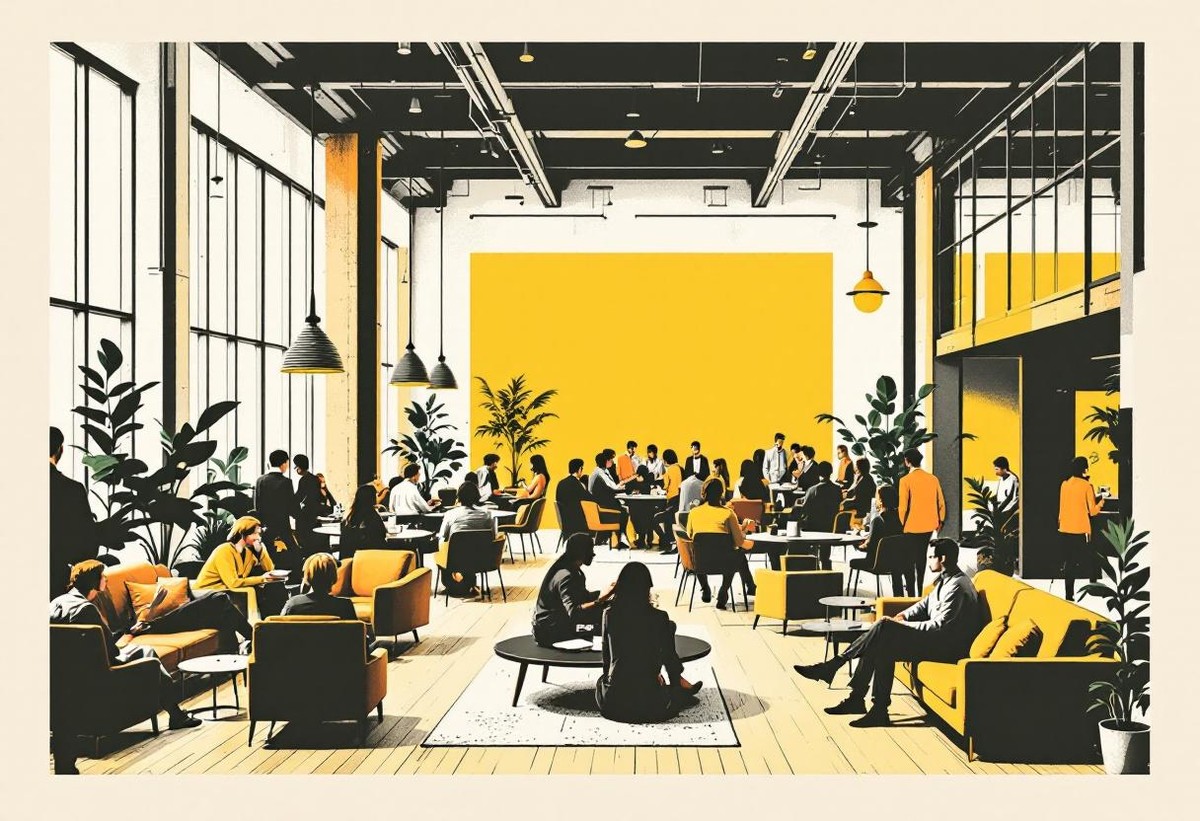
An unconference makes the agenda the networking: attendees pitch sessions in a circle, post them on a marketplace board and pick where to go, all in about thirty minutes. By the time the first session starts, everyone in the room knows who cares about what. You do not need to redesign a whole event - swap one post-lunch breakout for a 90 minute Open Space round. Here is how to run it.
I have stood at the back of a lot of conferences watching organisers wonder why the networking is flat. The agenda was tight, the speakers were good, the coffee was hot, and most attendees still ended the day with the same two business cards they arrived with.
The flaw is structural. A normal conference treats networking as a residue - whatever people manage to do around the edges of an agenda the organisers wrote for them. The unconference format treats it as the agenda.
My take: unconferences are one of the most effective conference session formats ever invented for a room of adults, and they are wildly under-used outside the tech and learning communities that have used them for twenty years. This piece is the case for using one - or, more practically, for stealing a 90-minute block of one and bolting it onto the event you already run.
What an unconference actually is
An unconference is an event where the people in the room set the agenda. Organisers provide the venue, the rough start and end times, the rooms, and a marketplace structure. They do not provide the content.
The day usually opens with a circle. Anyone who wants to host a session steps in, announces their topic in one sentence, and writes it on a card. The cards go onto a marketplace board against a grid of times and rooms. Everyone walks the board, signs up, and the schedule for the rest of the day is set in about thirty minutes. Sessions are short - typically 45 to 60 minutes - and follow what Open Space Technology calls the Law of Two Feet: if you are not learning or contributing, walk to a session where you are (OpenSpaceWorld, 2024).
Open Space Technology was developed by Harrison Owen in the mid-1980s after he noticed the most useful conversations at the conferences he organised were happening in the coffee breaks. He designed a format that was nothing but coffee breaks, with structure. BarCamp followed in 2005 and Lean Coffee in 2009. The lineage matters because all three are road-tested in adult professional settings, not novelty conference hacks.

Three formats that work for grown-up audiences
There are dozens of unconference variants. These three have the longest track record.
Open Space Technology
The classic. Best for groups of 60 to 300, ideally with a clear theme - a strategic question the community is genuinely trying to work out. The opening circle and the marketplace are non-negotiable; everything else is optional. Open Space surfaces the questions people are actually working on, not the ones they think they should be working on, which is why it produces unusually candid conversations and fast relationship formation.
Lean Coffee
The boardroom-friendly variant. A single table of 4 to 12 people writes topic ideas on sticky notes, dot-votes favourites, and works through them with a five-minute timer. When the timer goes, the table votes - keep going or move on. Lean Coffee is the easiest format to drop into a traditional event because a single 60-minute block does not require rebuilding the day. It pairs well with conference roundtable formats - same physical setup, different permission structure.
Self-organised tracks (BarCamp-style)
Best for technical or domain-deep audiences of 100 to 500. The day has named tracks - usually 4 to 6 - and attendees nominate, vote on and host sessions inside each track. BarCamp-style tracks work well when your community has clear sub-domains (engineering, design, product, ops) and the cross-track movement during sessions is part of the value.
Why the agenda creation is the networking
The reason these formats produce such strong networking is mechanical, not magical.
At a normal event, two things stop people from connecting. They don't know who else cares about the same thing they came for. And even if they do, they don't have a legitimate reason to interrupt a stranger. The marketplace solves both at once. When you write your topic on a card, you are publicly declaring what you are working on. When five other people sign up for it, you have just been introduced to the five people in the room most likely to be useful to you. The conversation is already permitted by the format.
Freeman's 2025 Networking Trends Report found that 60% of event teams do not actively manage networking at all - it sits in parallel with the agenda rather than inside it (Freeman, 2025). Unconferences invert that. There is nothing to manage in parallel because there is no parallel.
Harvard Business Review summarised research showing pandemic-era working patterns reduced people's working ties by an average of 17%, with weak ties - the bridging connections that produce most career opportunities - disproportionately lost (Harvard Business Review, 2023). Unconferences are unusually effective at producing weak ties: the format throws you into a room with people you would never have sought out, around a topic you both actually care about.
When unconferences are the wrong call
The format is not universal. There are three audiences I would not run one for.
Very large first-time audiences. If most of the room is attending for the first time, the marketplace produces thin gruel. People nominate topics they think they should care about rather than the ones they actually do. First-time-heavy events need more scaffolding, not less - that is the territory of inclusive networking ideas and structured icebreakers, not Open Space.
Senior corporate audiences expecting polish. If your audience came because the chief executive is keynoting, they are not in the mood to host a session. The format reads as informal in that setting and risks devaluing the ticket. Run a structured day and replace one block with Lean Coffee instead.
Rooms below about 30 people. The marketplace needs critical mass to produce variety. Below 30, you get four sessions, two of which collapse into the same room. At that size you are better off running a single facilitated discussion or a set of structured b2b networking session formats.
I would also pause before running an unconference where the smartest people in the room are all on the speaker line-up. The format only works when the smartest people are in the audience, willing to host a session about what they are actually working on.

How to bolt one onto a normal event
The lowest-risk way to use the format is to steal a 60 to 90 minute block from a traditional agenda and run an unconference inside it. The block I would pick, every time, is the post-lunch slot. Energy is at its lowest, attention to the main stage drops sharply, and people are already roaming. A marketplace at that point absorbs the energy that was leaking anyway.
Practical sequence for a 90-minute Open Space block inside a traditional day:
- Set up the wall before lunch. A grid of three 25-minute slots and four rooms or numbered tables. A pile of A5 cards and marker pens. Do this in plain sight so attendees walk past it on the way to lunch.
- Open with a five-minute brief. Anyone can host. Topics should be specific ("how do we get the ops team out of always-on incidents", not "the future of operations"). The Law of Two Feet applies. There are no observers.
- Run the marketplace for ten minutes. Hosts write a card, announce the topic in one sentence, place it on the wall. Attendees walk the wall and write their initials on the cards they want to attend.
- Run three 25-minute sessions. Use a chime to mark changes. Hosts capture three lines: discussed, agreed, follow up.
- Close with a five-minute harvest. Each host shares one line - what surprised them, what people agreed on, what they want to do next. The harvest is a public commitment moment and produces an unusually strong finish to the afternoon.
For a more ambitious test, run the unconference block on day two of a multi-day event, once attendees know each other. The marketplace will be richer, and the contrast with day one usually generates the strongest conference attendee engagement strategy feedback you are likely to get. If you want a starting point on whether your current event has the slack to absorb a block like this, our free networking gap calculator walks you through the numbers in about two minutes.
The bigger shift is to stop treating the agenda and the networking as two separate things. McKinsey's 2023 State of Organizations research found the highest-performing teams now prioritise self-organisation and connection over rigid hierarchy (McKinsey, 2023). The same shift is overdue at the conferences those teams attend. The unconference is the cleanest expression of it: trust the people in the room to know what they need to talk about, and your job becomes making that talk easy. That trust, more than the marketplace board or the Law of Two Feet, is what produces the networking. The format is just the permission slip.
Want the template I use when I plan networking into an event agenda?
I put a short operator's brief together - the three registration questions, the match format decision tree, the post-event follow-up template. Free, no email wall.
Frequently asked questions
What is an unconference format?
An unconference is an event where the agenda is set by the people in the room, not by the organisers. The day usually opens with a marketplace where attendees pitch sessions they want to host or attend, group themselves around the topics that get traction, and run those sessions for a fixed time. Three established variants are Open Space Technology, Lean Coffee and BarCamp-style self-organised tracks. The networking happens inside the agenda creation itself, not in the breaks around it.
Why do unconferences work for networking?
Because the format removes the two biggest blockers in a normal event: not knowing who else is interested in your problem, and not having a legitimate reason to start a conversation. When everyone has to nominate or vote on a topic, you instantly see who else cares about the same thing you came for. The conversation is already permitted by the format, so you skip the small-talk warm-up that swallows the first half of most coffee breaks.
When should I run an unconference instead of a normal conference?
Run an unconference when your audience is a returning community, technically or domain-deep, and the smartest people are not all on the speaker list. Avoid it when you have a high share of first-time attendees who need scaffolding, a corporate audience expecting a polished day, or fewer than 30 participants - the format needs critical mass to produce variety in the marketplace. A hybrid approach often beats the pure form: keep keynotes for the morning and run an unconference block in the afternoon.
Can I bolt unconference sessions onto a normal event?
Yes, and this is usually the lowest-risk way to test it. Pick one breakout block - typically the post-lunch slot when the formal agenda starts to flag - and replace it with a 60-90 minute Open Space round. Keep the rest of the day on the regular agenda. You get most of the connective benefit without rebuilding the event, and you can compare the energy in the unconference block to the rest of the day on the same survey.
How many people do you need for an unconference?
The format works best between 30 and 300 participants. Below 30, you don't get enough topic variety in the marketplace to sustain parallel sessions. Above 300, you need physical-space management - multiple rooms, signage, a chime to mark session changes - or you break the room into parallel mini-marketplaces of 50 to 100 each. Open Space Technology has been run with thousands of participants, but the production complexity rises sharply at that scale.
How do I capture what happens in an unconference?
Pre-print or pre-share a short template per session: who hosted, who attended, three things we discussed, two things we agreed on, one thing we will follow up on. Collect the templates at the end of the day. The notes are useful, but the more valuable artefact is the contact graph - who was in which room with whom - which becomes a ready-made post-event introduction list the organiser can send within 48 hours.
About the author
Cate Trotter
Co-founder and Product Lead, All Along
Cate is co-founder and product lead at All Along. She's spent 15+ years helping organisations turn emerging tech into commercial results, and founded and sold two retail-focused businesses before building All Along. She writes about how events can turn networking from a happy accident into a repeatable outcome.
Connect on LinkedInReady to make networking the reason people come back?
All Along gives every attendee three people they should actually meet, and gives you a complete picture of what your audience wants.
More from Field Notes
B2B event networking for sales teams: a three-touch framework
Sales teams arrive at B2B events with a budget, a quota and no plan. The teams who do this well treat the event as the middle of a conversation, not the start.
The case for transparent event matchmaking
If an attendee asks why they were paired with someone, an organiser who cannot answer has a product problem, not a communication problem.
Event networking by event type: one framework, six formats
One networking format does not fit six different kinds of event. Three questions that tell you the design any event type actually needs.